
How does an ancient spiritual tradition stay alive in the age of AI, climate change, and social transformation? Sanatana Dharma is not a relic- it is eternally relevant, offering profound insights for the modern world.

Sanatana Dharma & the World
Explore how dharma interacts with modern ethics, global issues, ecology, interfaith dialogue, and contemporary life beyond India.

“You Are Not You”: Mark Twain Meets Vedānta on the Illusion of Self
“Nothing exists. All is a dream. God—man—the world—the sun, the moon, the wilderness of stars—a dream, all a dream; they have no existence. Nothing exists save empty space—and you. And you are not you—you have no body, no blood, no bones, you are but a thought.”— Mark Twain, The Mysterious Stranger Twain’s Paradox — Or…
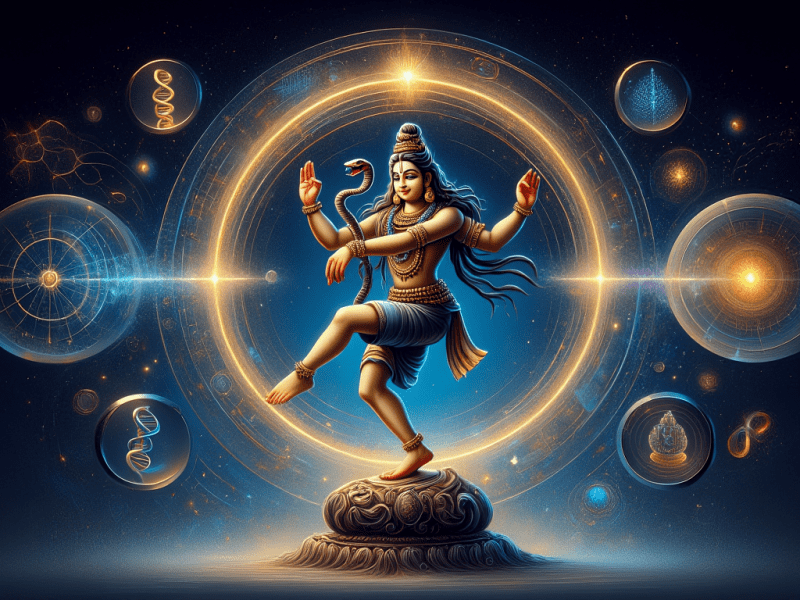
Sanātana Dharma: The Eternal Continuum
Sanātana Dharma literally means “the Eternal Order” which conceives of reality as without a beginning or end. The Sanskrit term sanātana signifies “timeless, ever-present,” and dharma denotes that which upholds, the sustaining law or principle. Central to this worldview is the concept of the ātman (आत्मन्, “soul” or “Self”), an indestructible spark of the universal…
Science, Consciousness & Dharma
Dive into the meeting ground of science and spirituality — where quantum physics, cosmology, and neuroscience echo ancient Vedic insights on consciousness and reality.

When Revati visited Brahma: Time Dilation in Hindu Scriptures
Introduction Time is not absolute — a fact well-known in modern science through Einstein’s theory of relativity. Yet, this very idea appears in ancient Hindu scriptures as well, especially in a fascinating tale involving Revati, daughter of King Kakudmi, and her visit to Lord Brahma. What she experienced reveals a deep philosophical understanding of time,…
Misunderstood Dharma
Clarify modern myths around caste, idol worship, rituals, gender, and more. Return to the scriptural truth and restore what has been lost or distorted in public discourse.
“चातुर्वर्ण्यं मया सृष्टं गुणकर्मविभागशः ।”
Chāturvarṇyaṁ mayā sṛṣṭaṁ guṇa-karma-vibhāgaśaḥ
— Bhagavad Gita 4.13


 The Sanatana Project