
Most devotees know Śrī Rādhā and Śrī Kṛṣṇa as the eternal divine couple — embodiments of love, beauty, and bhakti. Yet, a common narrative circulates that Rādhā and Kṛṣṇa were never married. This idea has been repeated so often that many assume it to be true, and some even use it to present their relationship as merely symbolic.
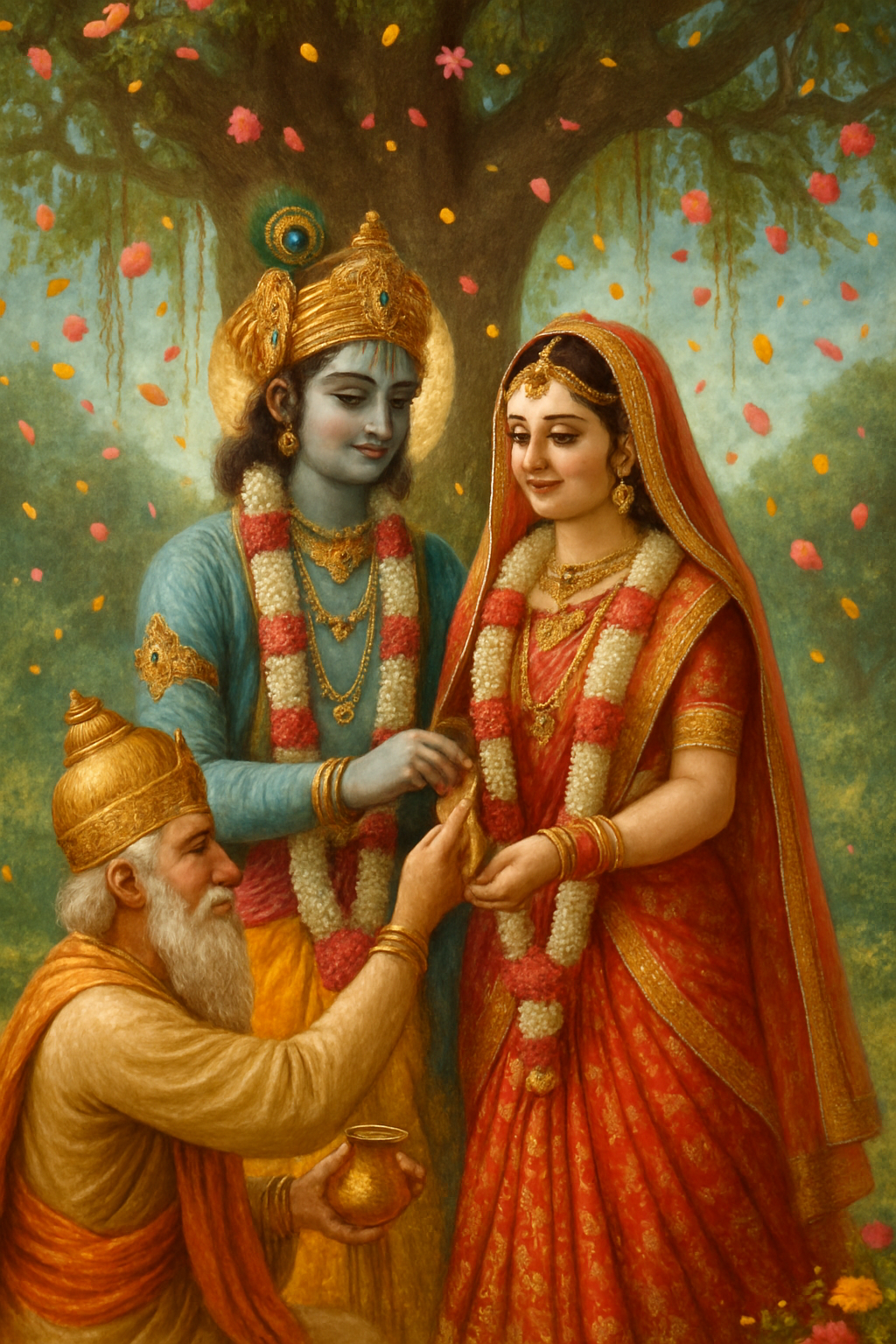
But if we turn to the scriptures, we find a different story — one that takes us to the sacred groves of Bhandīrvan in Vṛndāvana, where Lord Brahmā himself solemnized the wedding of Śrī Rādhā and Śrī Kṛṣṇa.
The Sacred Forest of Bhandīrvan
Bhandīrvan, one of the twelve vanas (forests) of Vṛndāvana, is filled with legends of divine pastimes. Even today, there stands the ancient Bhandīrvat tree, revered as the witness of their marriage.
According to the Garga Saṁhitā, in this very forest, Lord Brahmā descended from Satyaloka to perform the vivāha-saṁskāra (marriage ceremony) of the divine couple.
Scriptural References: Garga Saṁhitā
The Garga Saṁhitā (Goloka-khaṇḍa, Chapter 16) offers a vivid description of the event:
“Lord Brahmā performed the wedding ceremony of Śrī Hari and Śrī Rādhikā. He had Them circumambulate the sacred fire seven times, bow down in reverence, and sanctified the marriage with the recitation of seven Vedic mantras.”
(1.16.32)
“Then Lord Brahmā, the knower of the Vedas, came to Bhandīrvan and performed the wedding of Śrī Rādhā and Śrī Kṛṣṇa. The supremely beautiful Yogeśvara Kṛṣṇa married Śrī Rādhā there, being worshipped by the devas and siddhas.”
(1.16.34-35)
This testimony shows not just that a marriage took place, but that it followed a complete Vedic ritual with fire, mantras, and divine witnesses.
Why the Marriage is Overlooked
So why do many believe Rādhā and Kṛṣṇa were never married? Several reasons contribute:
- Līlā and Symbolism: In Vṛndāvana-līlā, their love is portrayed in its sweetest, most spontaneous form — free from worldly conventions. For this reason, poets and bhaktas often highlight the parakīya-rasa (love beyond social bonds) as the highest expression of bhakti.
- Selective Narration: Not all Purāṇas and texts narrate the marriage, while the Garga Saṁhitā and certain Vaiṣṇava traditions preserve it in detail. Over time, the story was eclipsed in popular retelling.
- Philosophical Depth: The truth is that Rādhā and Kṛṣṇa are one soul in two forms — the eternal divine feminine and masculine. Whether married or not in human terms is secondary; their union is transcendental.
Rādhā’s Eternal Ontological Status
To understand why the marriage at Bhandīrvan is not just symbolic, but a divine truth, we must look at Rādhā’s eternal identity in the śāstras:
Nārada-pañcarātra
“Radha is Gokuleśvarī, the full embodiment of spontaneous love and the personification of mahābhāva [the highest spiritual state]. Bhagavān Śrī Krishna, who is the supreme Īśvara of all existence and the God among gods, is attained by Her mercy. Śrī Radha is Krishna’s internal potency, and She performs worship of Her most beloved Śrī Krishna with the entire wealth of Her devotion and service.”
Implication: Rādhā is the embodiment of bhakti itself. As Krishna’s Hlādinī-śakti (bliss potency), She is inseparable from Him. Their union at Bhandīrvan is therefore not merely human-like, but cosmic.
Sammohana-tantra
Goddess Durgā declares: “The name Durgā, by which I am known, is Her name. The qualities for which I am famous are Her qualities. The majesty with which I am resplendent is Her majesty. That Mahā-Lakṣmī, Śrī Radha, is nondifferent from Śrī Krishna. She is His dearmost sweetheart and the crest-jewel of His beloveds.”
Implication: Radha is not a mortal gopī invented by later poets. She is the source of Lakṣmī and Durgā, and the eternal Śakti of Krishna. Their marriage is thus the eternal union of Śakti and Śaktimān (the Energy and the Energetic).
Phulera Dooj and Its Significance
Every year, according to the Hindu lunar calendar, Phulera Dooj is observed on the second day (Dvitīyā tithi) of the bright half (Śukla Pakṣa) in the month of Phālguna. This festival is dedicated to Śrī Rādhā-Kṛṣṇa and holds a very special place in the traditions of Braj.
On this day:
- Devotees perform ceremonial worship of Rādhā and Kṛṣṇa with devotion.
- Flowers are offered and showered upon the divine couple, signifying purity, beauty, and the blossoming of eternal love.
- Across Vrindavan, Barsana, Nandgaon, and Bhandirvan, the atmosphere becomes festive with music, kīrtan, and colorful celebrations.
Phulera Dooj commemorates the divine wedding of Śrī Rādhā and Śrī Kṛṣṇa at Bhandirvan, where Lord Brahmā himself officiated Their marriage. Thus, it is not only a celebration of joy and beauty but also a remembrance of Their eternal union.
Conclusion
The wedding of Śrī Rādhā and Śrī Kṛṣṇa at Bhandīrvan is beautifully preserved in the Garga Saṁhitā, where Lord Brahmā himself acts as priest. Far from being a myth, it is a sacred truth — one that deepens our understanding of the divine couple’s eternal bond.
Next time someone says, “But Rādhā and Kṛṣṇa were never married,” remember the testimony of the scriptures and the witness of the Bhandīrvat tree in Vṛndāvana.
Rādhā–Kṛṣṇa are not just lovers. They are the eternal, wedded divine couple — the very embodiment of the soul’s union with the Supreme.


 The Sanatana Project
Leave a comment