
Sanātana Dharma literally means “the Eternal Order” which conceives of reality as without a beginning or end. The Sanskrit term sanātana signifies “timeless, ever-present,” and dharma denotes that which upholds, the sustaining law or principle.
Central to this worldview is the concept of the ātman (आत्मन्, “soul” or “Self”), an indestructible spark of the universal brahman (ब्रह्मन्), the ultimate spiritual reality. Unlike traditions that see soul and divinity as distinct, Sanātana Dharma holds that the individual soul (jīvātman) is of the same essence as the paramātman (supreme Self), and thus shares its eternality.
Bhagavad Gītā 2.20
न जायते म्रियते वा कदाचिन्न्
नायं भूत्वा भविता वा न भूयः।
अजो नित्यः शाश्वतोऽयं पुराणो
न हन्यते हन्यमाने शरीरे॥
“The soul is never born and never dies; nor having once existed does it ever cease to be. This soul is unborn, eternal, everlasting, and ancient; it is not slain when the body is slain.”
Further, this ties into the greater cosmic continuity described throughout the Mahābhārata and the Upanishads. For example, in the Chāndogya Upaniṣad (6.8.7):
“Tat tvam asi” (तत्त्वमसि)
— “That thou art” – declaring the essential oneness of soul (ātman) and the Supreme Reality (brahman).
Sanātana Dharma’s deepest message is that neither the soul (ātman), nor the universal law (dharma), nor the cosmic cycles themselves can ever “end.” The individual merely passes through cycles of manifestation (janma), maintenance, dissolution (mṛtyu), concealment, and renewal—the same dynamics that rule the universe as personified in Shiva’s cosmic dance.
Shiva Nataraja: The Cosmic Dancer
A. The Symbolism of Tāṇḍava (ताण्डव)
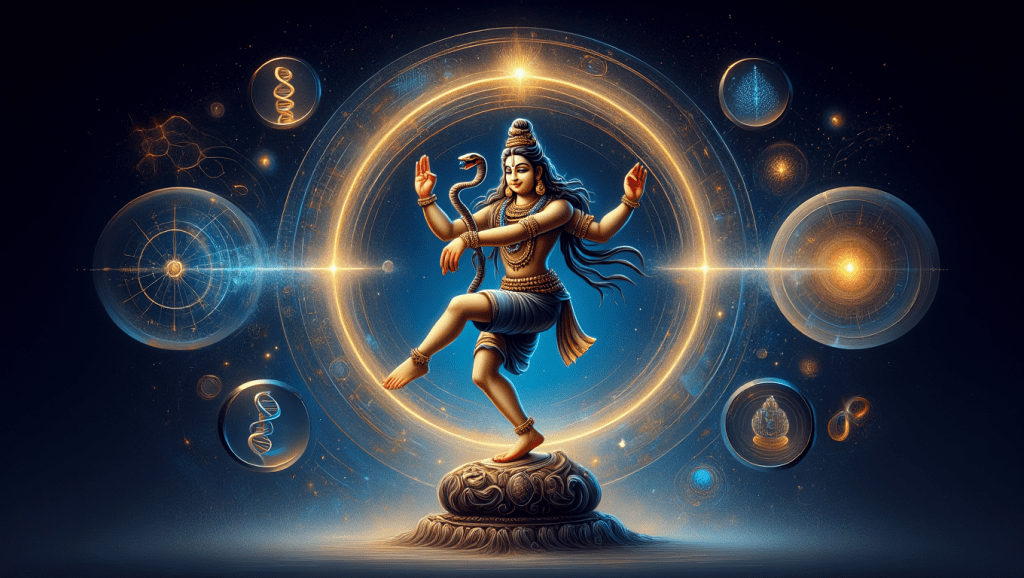
Shiva as Naṭarāja (नटराज, “Lord of the Dance”) stands as an iconic representation of cosmic rhythms. Every gesture in this form is laden with metaphysical meaning:
- The upper right hand holds the ḍamaru (drum), beating out the originary pulse of creation, the Nāda (sound-current).
- The upper left-hand bears agni (fire), symbolizing dissolution and transformative power.
- The lower right hand shows abhaya mudrā (protection, banishing fear).
- The left foot raised upward offers moksha (liberation), while the right foot crushes apasmāra (personification of ignorance).
The fiery arch encircling Shiva denotes the ever-cycling universe. In this dynamic poise, we see the reflection of fivefold cosmic functions: creation, preservation, destruction, concealment, and grace performed ceaselessly by the Divine.
B. Scriptural Insights: The Cosmic Dance
The Śvetāśvatara Upaniṣad 3.2 praises the transcendence of Shiva (Rudra):
एको ही रुद्रो न द्वितीयाय तस्था
य इमाँल्लोकाँ ईशत ईशनीभिः।
प्रत्यङ् जनाँस्तिष्ठति सञ्जुर्वेदाः
प्रेति विश्वा भूतेशु गुहाशयान्तः॥
“Rudra is indeed One, there is no second. He governs all the worlds by his lordly power, stands within all beings, and dwells within the cave of the heart.”
In the Shiva Purāṇa, Rudra Saṃhitā (Satī-khaṇḍa) Chapter 19, it is described that when Shiva dances, both creation and dissolution are set in motion. At the culmination of the universe’s lifespan, it is said:
“He who creates, at his will, the entire cosmos, and dissolves it into himself by his dance at the end of time.”
The Śiva Tāṇḍava Stotram, attributed to Rāvaṇa, also glorifies this dance:
डमड्डमड्डमड्डमन्निनादवड्डमर्वयं
चकार चण्डताण्डवं तनोतु नः शिवः शिवम् ॥१॥
ḍamaḍḍamaḍḍamaḍḍamanninādavaḍḍamārvayam
cakāra caṇḍa-tāṇḍavaṃ tanotu naḥ śivaḥ śivam ||1||
“With the resounding beat of the ḍamaru, He performed the fierce Tāṇḍava; may Shiva shower his auspiciousness upon us.”
The Cycles of Time: Yugas, Kalpas, and Pralaya
A. Chaturyugas: Quadrants of Cosmic Time
Sanātana Dharma visualizes time as repeating cycles, not a straight line. Four Yugas (epochs) rotate in a great round known as the Mahāyuga or Chaturyuga:
| Yuga | Duration (divine years) | Duration (human years) | Characteristic |
| Satya/Kṛta | 4,800 | 1,728,000 | Truth pre-eminent, dharma at its fullest |
| Treta | 3,600 | 1,296,000 | Ritual power, dharma weakened by a quarter |
| Dvāpara | 2,400 | 864,000 | Conflict rises, dharma halved |
| Kali | 1,200 | 432,000 | Discord, materialism, loss of dharma |
Viṣṇu Purāṇa 1.3:
“The Krita [Satya] Yuga has 4,800 divine years, Treta 3,600, Dvapara 2,400 and Kali 1,200. A day of Brahmā equals one thousand such Mahāyugas, after which annihilation comes.”
B. Pralaya: Cosmic Dissolution and Renewal
After each cycle, the universe dissolves in a great pralaya (“dissolution”), returning all manifested existence to its unmanifest source. This is not an apocalypse in the Western sense, but an integral transformation and renewal.
Viṣṇu Purāṇa 1.3.7–10:
“When Brahmā’s day ends, all beings, from the highest to the lowest, are dissolved, and only the One exists. At the dawn of creation, with the will of the Supreme, all arise again.”
Types of Pralaya:
- Naimittika Pralaya: Dissolution at the end of a kalpa (Brahmā’s day), affecting only certain planes.
- Mahāpralaya: Total dissolution at the end of Brahmā’s lifespan (100 Brahmā years = 311 trillion human years).
After pralaya, the creative impulse awakens once more, repeating the endless play (līlā) of manifestation. This cosmic rhythm mirrors the perpetual dance of Shiva.
Contemporary Resonance: Nataraja in Modern Thought and Science
The vision of cosmic continuity is not confined to temples or texts; it finds echoes in contemporary culture and science:
- Chidambaram Temple (Tamil Nadu): Ancient lore upholds this sacred temple as the physical nexus of Shiva’s cosmic dance. Within the golden hall, silence itself is said to resound with the unseen Tāṇḍava—teaching that the universe’s apparent stillness is woven from ceaseless vibration.
- CERN and the Nataraja Statue: At the European Organization for Nuclear Research (CERN), a two-metre statue of Shiva as Nataraja stands prominently. Installed as a symbol of the deep synergy between science and spirituality, it reminds visitors of the metaphysical vision in which all matter is energy in motion—parallel to the dance of subatomic particles. A plaque cites physicist Fritjof Capra: “Modern physics has shown that rhythm or dance is universal…”
- Scientific Metaphors: Many physicists have pointed out resonance between the dynamic equilibrium of Shiva’s dance and models of quantum reality—illustrating how ancient metaphors continue to illuminate the frontiers of human thought.
Conclusion: The Never-Ending Dance
Sanātana Dharma’s vision of an eternal, rhythmic cosmos—anchored in the realization that soul (ātman) is inseparably part of brahman—offers a perspective where beginnings and endings fade into cycles of renewal.
This continuity is not mere abstraction, but a call to live with reverence, equanimity, and openness to both change and stillness. Life, death, creation, and dissolution: all are steps in Shiva’s dance.
Bhagavad Gītā 2.12
न त्वेवाहं जातु नासं न त्वं नेमे जनाधिपाः |
न चैव न भविष्याम: सर्वे वयमत: परम् ||
“There never was a time when I did not exist, nor you, nor these kings; nor will there be a time when any of us shall cease to be.”
Thought-Provoking Questions
- How does understanding the cyclical vision of time in Sanātana Dharma change our attitudes towards life, death, and renewal?
- What can the symbolism of Nataraja teach us about embracing both transformation and balance in times of uncertainty?
- Are there echoes of these cosmic principles in your personal experiences or in the scientific worldview?
References
- Bhagavad Gītā 2.12, 2.20
- Chāndogya Upaniṣad 6.8.7
- Śvetāśvatara Upaniṣad 6.18
- Shiva Purāṇa, Rudra Saṃhitā, Chapter 19
- Viṣṇu Purāṇa 1.3.7–12
- Bhāgavata Purāṇa 3.11.18–20
- Shiva Tāṇḍava Stotra, Verse 1


 The Sanatana Project
Leave a comment